Derek Sivers built the online shop that let independent musicians sell their records when no one else would, ran it for a decade, sold it in 2008 and sent the proceeds to a trust for music education. Since then he has become something harder to file: the author of five short books, a programmer who runs his own server, a resident or citizen of six countries, and a public figure who still answers every email himself. What drew us in is the consistency underneath all that movement. Here is someone who once ran a company of 85 people and has spent the years since arranging his life so he can deal with the world one person, one sentence and one hour at a time.
The shop that started as a favour
A little context for anyone under forty. In 1997 there was no iTunes, no Spotify, and no way for a musician without a record label to sell a CD to a stranger online. Derek had graduated from Berklee College of Music, toured Japan as Ryuichi Sakamoto's guitarist, and spent ten years as ringleader of a travelling circus (roughly a thousand shows). He wanted to sell his own album from his website in Woodstock, so he went through the considerable trouble of getting a merchant account. Friends asked if he would list theirs. Then strangers called. CD Baby grew into the largest seller of independent music on the web, with more than a hundred million dollars passed through to around 150,000 artists, and by 2003 Esquire was calling him one of the last folk heroes of the music business.
The detail we keep returning to is that the shop was built to maximise the musician's cut rather than the company's, which sounds obvious until you remember how the rest of that industry worked. It also set a pattern that has held for thirty years: Derek solves a problem for himself, then leaves the door open. The merchant account became CD Baby. The notes he keeps so he will remember what he reads became a public library covering more than 400 books. The server he set up so no company could lose his data became a step-by-step guide anyone can follow. This autumn, after years of writing code only for himself, he began publishing that too.
The unit of one
The unit of one
He once ran a company of 85 people. Nearly everything he has built since is sized for a single person at a time. Four examples.
One sentence per line
His drafts put every sentence on its own line, so each one can be judged alone. If a chapter turns out to hold two ideas, one gets moved out into its own chapter. The result averages around twenty-two sentences a chapter.
The smallest unit of thought gets the whole room.
One email, 92,354 times
A four-year sabbatical, 2014 to 2018, in which he replied to every message from nearly 34,000 people. No team, no assistant, no autoresponder. When bot spam arrived he built a whitelist for blog comments rather than shutting them off.
The systems exist to protect the one-to-one.
One room, fifty conversations
A trip to Bangalore: one hotel, nine days, a new visitor every two hours, and not a single step outside. The people had written to him first over the years.
Travel reduced to the one thing he actually wanted from it.
Thirty hours, one kid
At least thirty hours a week since 2012, phone powered fully off, following the child's schedule rather than fitting him into an adult one. He moved to a town where he knew nobody to make that possible.
The same rule he applies to a sentence, applied to a person.
The producer's ear
Derek came out of Berklee as a composition, synthesis and production generalist, then spent twelve years running a recording studio where he often played every instrument on a track. Read his books with that in mind and the studio is audible. His chapters average around twenty-two sentences, and he drafts with one sentence per line so he can see the rhythm of long and short on the page the way an engineer reads waveforms. His last two books had no outside editor; he edits while writing, the way a producer mixes while tracking. Even his most ambitious book, which offers twenty-seven conflicting answers to the question of how to live, reads to us as an arrangement problem rather than an argument: nobody asks which instrument is best, each one gets its solo.
The lesson here reaches well beyond writing. Craft learned deeply in one field becomes a transferable instinct for shape. Derek's prose is spare because he spent fifteen years learning what a song can do without, and that is a far more interesting kind of minimalism than owning fewer chairs.
Independent, in the fullest sense
Here is the connection we find most satisfying. For ten years Derek built the infrastructure that let musicians skip the label. Then he became the kind of creator that infrastructure was for. His books go out with a friend handling the paper and binding and nobody else in the chain. His website is hand-written code on a machine he administers, running tools chosen because their incentives will not drift. He edits every interview transcript by hand so the record of what he meant lives somewhere he controls. The reasoning is simple and a little sobering: he was online in 1994 and watched the first generation of beloved companies vanish with everyone's uploads. He assumes he will outlive every platform, and builds accordingly.
The surprising part is that this self-reliance comes with a wide-open front door. The contact form on his site asks only that you prove you are human. During a four-year sabbatical he answered more than 92,000 emails from nearly 34,000 people, and he treats that inbox as one of the pleasures of his life rather than a cost. Many of his closest friendships began there. Ownership of the machinery, in his hands, is what makes the intimacy affordable.
- A town with a population of twoOregon coastSeven months alone in a cabin by an empty coast, writing and recording full time. The album that followed came out of this stretch.[1] [5]
- A town where he knew nobodyNelson, New ZealandLeft a busy social life in Singapore for a place with no acquaintances at all, so a baby could have his full attention.[5] [6]
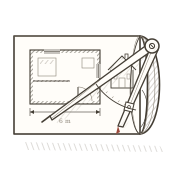
- A cabin he drew himselfThe New Zealand bushDesigned his own cabin in the woods. The work inside is the same as it was in 1993: writing, code, thinking. The difference is that the inbox is now open to the whole world.[1] [2]
A citizen several times over
Derek left America at forty and has since become a legal resident or citizen of Singapore, India, Belgium, New Zealand, England and Portugal. What strikes us is the instrument he chooses for exploring. Calling oneself global is easy; he fills in the nine months of paperwork. Commitment in its most binding administrative form, paired with a suitcase that never fully unpacks, is an unusual combination, and it says something about how seriously he takes the idea of belonging somewhere.
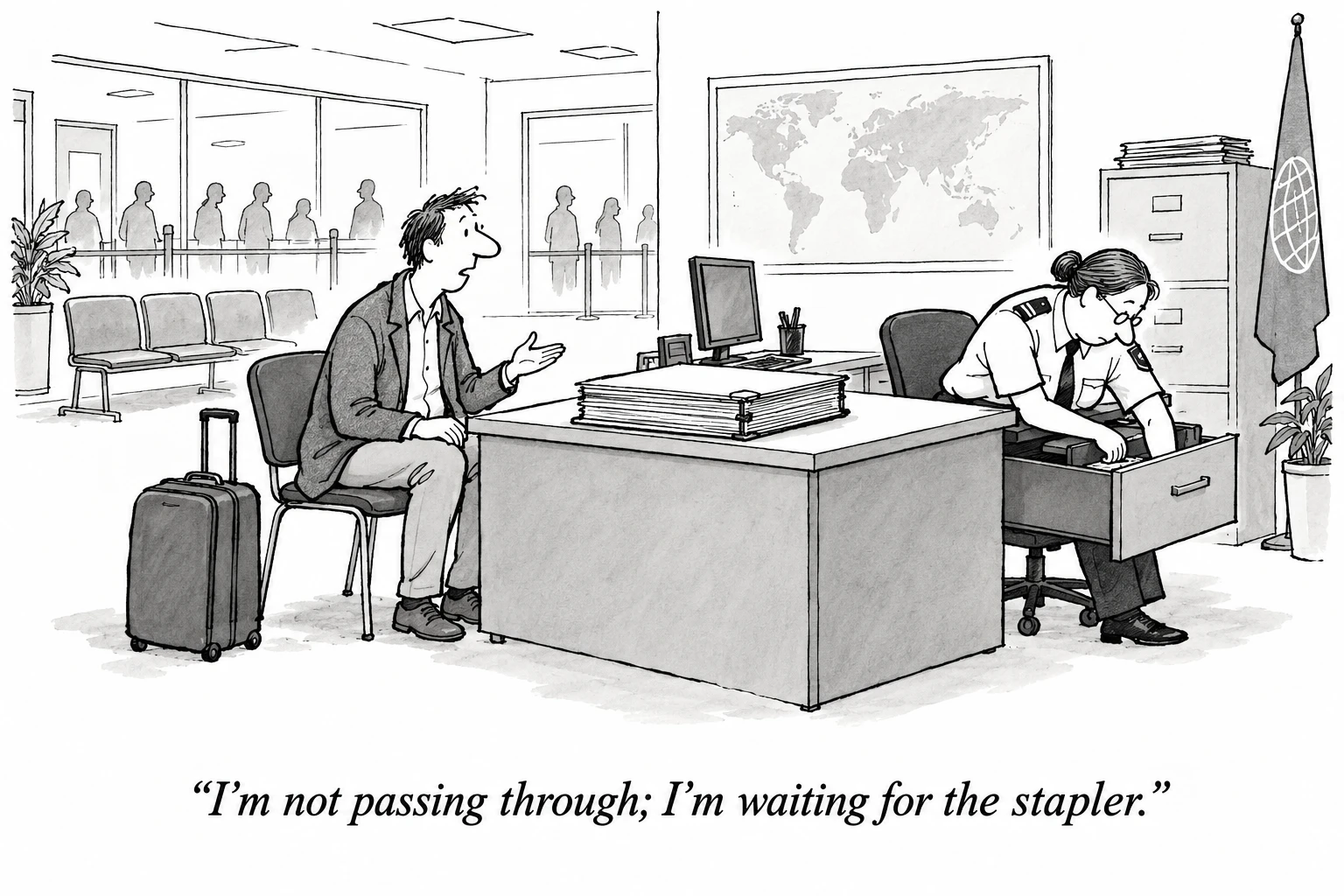
Lately the exploring has turned toward people rather than places. A trip to Bangalore became fifty hour-long conversations in nine days, most with people who had first written to him, without once leaving the hotel. This month it was Istanbul. In a few weeks he will cross China by train from Beijing to Hong Kong with Kevin Kelly, in a country he has visited four times in a year and whose language he is learning character by character. The project underneath, as we read it, is to dissolve the category of "those people" one acquaintance at a time, and it is hard to think of a better use for a man who likes talking to strangers.
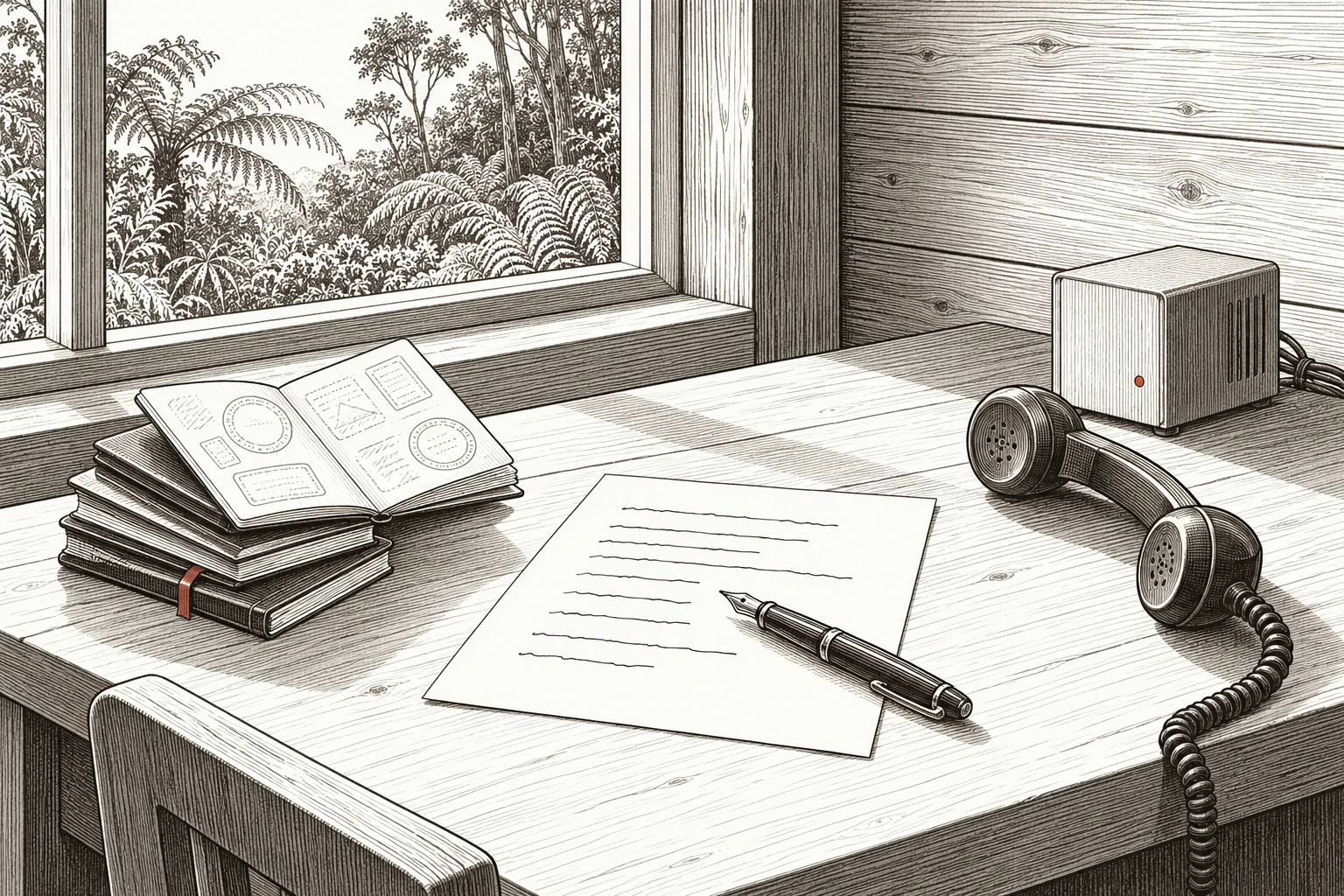
For now the calendar bends around a fourteen-year-old. Since his son was born Derek has given him at least thirty undivided hours a week, every device switched off, and he moved to New Zealand for the sole purpose of raising him somewhere with more trees than shopping malls. His plan, once the boy heads off to university, is to live three to twelve months at a time in one place after another, properly, as a local. He is already rehearsing. In the meantime there is a cabin in the woods that he drew himself, a database full of sentences, and a programmer bouncing out of bed at five in the morning for the first time in years. Whatever he makes next, the method is already visible: build it for yourself first, keep it small enough to hold in one hand, and leave the door open.