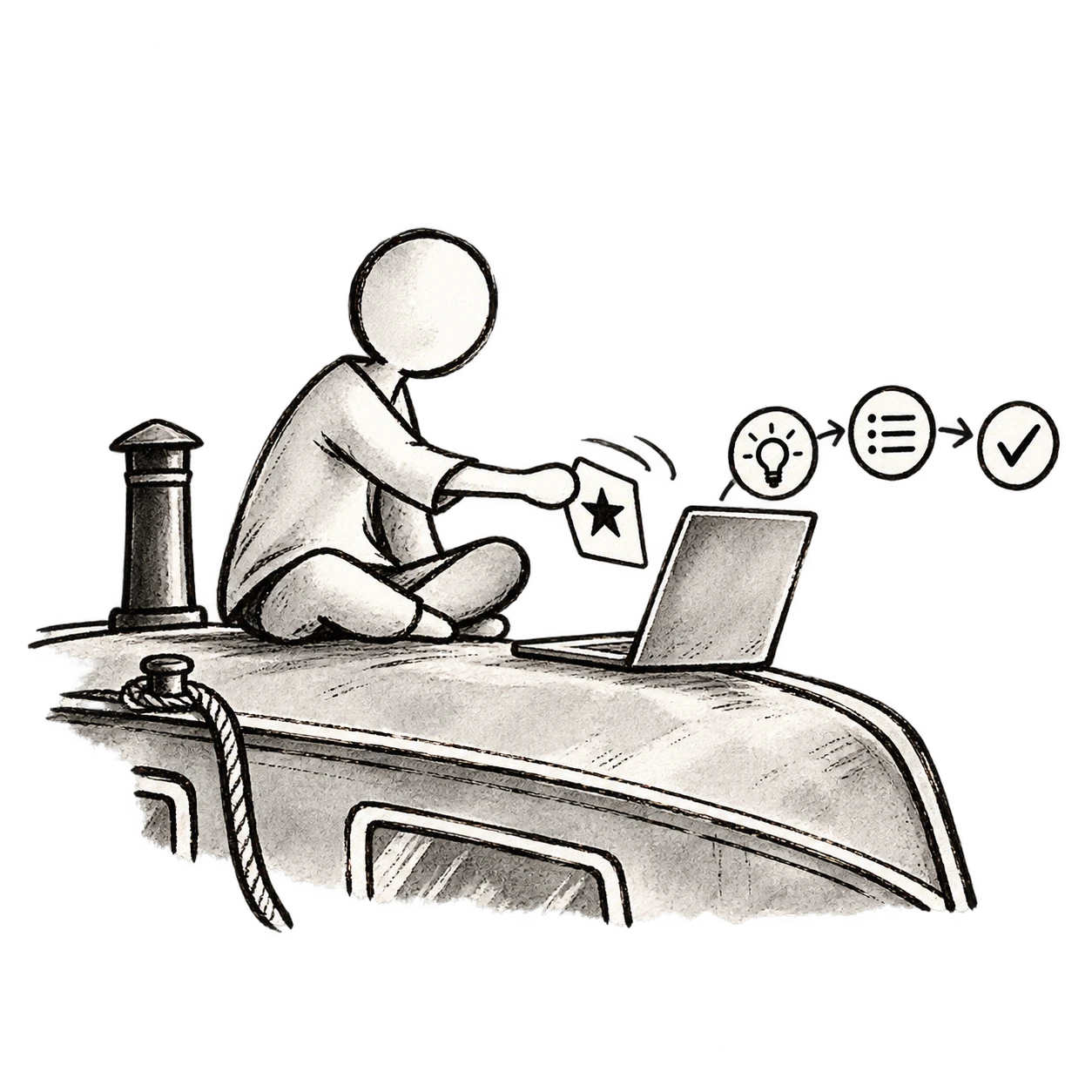
Ivan Podgurskiy is a London software engineer who has been the technical head of a startup straight out of university, founded another, directed short films and, most recently, built a website that trains people to read tarot, all while living on a boat. What made us look twice was not the range itself but a pattern hiding inside it: almost everything Ivan has built is a machine for helping something, or someone, explain itself.
Learning a language by living inside it
Ivan was born in Russia and came to Britain as a teenager, before university, to do his A-levels and bring his English up to the standard the next step would demand. That is immersion rather than tuition: you learn the language by needing it at breakfast. The next step turned out to be Imperial College London, which runs one of the most mathematically demanding computer science degrees in Europe, and he came out with a Master of Engineering in 2015.

Two things about those years tell you more than the degree does. By his second year he was already working as a contract developer for paying clients, which is to say he was running a one-person business before he could legally hire a van. And in 2014 he did a seven-month stint as a technology analyst at Barclays' investment bank, the kind of placement that, for an Imperial computing student, is usually the on-ramp to a long and comfortable career in finance. Ivan took the ramp, looked around, and got off. He would spend the next decade in companies small enough that everyone knew what everyone else was building.
Best in the first act
Best in the first act
Ivan has run the technical side of a bank desk, several startups and a film set. The thread isn't an industry. It's a preference for the part where everything is still being invented.

Seven months at the bank
For an Imperial computing student, a placement at an investment bank is the well-lit road: stable, well paid, prestigious. Ivan took it in 2014 and was gone by autumn.
Some people need a decade to learn which rooms they do their best work in. He learned it before he had his degree.
Chief technology officer at graduation
Most new graduates join something. Ivan became the technical head of a startup the same year he finished his Master's, then did the same job for two more young companies.
The stints were short because the job was: build the first version, make the early decisions that are hardest to undo, hand over something that works.
A film set is a startup with a wrap date
When he went off to direct short films, the job description barely changed. Hold the whole thing in your head. Give a small crew of specialists something precise to aim at. Ship by a date you can't move.
It looks like a swerve from the outside. From the director's chair it is the same muscle.
Machines that show their working
His final-year project at Imperial is the clue we keep coming back to. He built a web tool for a kind of artificial intelligence that reasons with explicit rules rather than statistics, and the tool's whole purpose was to draw, as a picture, why the system had concluded what it concluded. In 2015, years before "explainable AI" became a conference track, a student was making a reasoning engine justify itself to a human in a diagram. The work was good enough to inform a public research tool that followed.
Hold that idea and the rest of his CV rearranges itself. HireFunnel, the company he founded in 2018, let job candidates answer interview questions on video in their own time; underneath the scheduling convenience, it was a tool for letting people explain themselves. Trint, where he spent three and a half years as a software engineer, was founded by an Emmy-winning war correspondent who had hand-transcribed decades of interviews and wanted a machine to turn speech into text a journalist could edit. And then there is Practice Tarot, which looks like the odd one out until you see how it is built. It is not a dictionary of card meanings. It hands you a stranger's real dilemma, deals you a card, and uses software to judge whether you can turn a set of symbols into a coherent story that actually answers the question. Strip away the candles and that is his student project again: get from symbols to an explanation a person can follow.
- A reasoning engine that explains itselfFinal-year project, Imperial CollegeA web tool that drew, as a diagram, why a rule-based AI had reached its conclusion. Explainability years before it was fashionable, and the seed of everything after.[1]
- Letting candidates explain themselvesHireFunnel, founderVideo interviews recorded in the candidate's own time. Billed as a scheduling fix; really a stage for people to tell their own story to a camera.

- Turning speech into something you can editTrint, software engineerThree and a half years at a transcription company started by a war correspondent. Recorded voices become text a journalist can search, cut and correct.

- From symbols to a story that answers the questionPractice TarotA trainer that deals you a card against a stranger's real dilemma and scores whether your reading forms a coherent, useful narrative. The student project again, in costume.

It is also, we suspect, not a coincidence that the site teaches by practice rather than memorisation. That is how Ivan learned English.
The director's chair
After HireFunnel, Ivan went and made short films, including one called Biscuits in 2022 with a small London cast. Plenty of engineers daydream about directing; the number who finish a second film is much smaller, and the number who then go back to shipping software without any sense of having failed at the first thing is smaller still.
We would argue the move is less of a swerve than it looks. A technical lead at a tiny startup and a director on a short film have essentially the same job: hold the entire thing in your head, give a crew of specialists something precise to aim at, and deliver by a date you cannot move, to an audience who will not care how hard it was. Ivan's startup roles were short and intense, the first act of each company, when everything is being invented and one person has to keep the whole picture in view. A film set is that act with a wrap date. The skill transferred because it was the same skill.
A home you can untie
Ivan lives on a canalboat in London. A few thousand people do, on a ribbon of water that runs from Little Venice through Camden and out to the Lea, and for those without a permanent mooring the rules require the boat to move every couple of weeks. Whether or not that applies to him, the choice says something a flat in Hackney would not. He has arranged his life so that the fixed costs are low, the footprint is small, and the next chapter, whether a contract, a film or a stretch of travel, does not require dismantling the current one.

That is the part of his story we think is most worth borrowing. People talk about keeping their options open as if it were a mood. Ivan treats it as an engineering problem, with a solution you can moor. Right now he is building again: contract engineering work for other people's companies, and his own projects like Practice Tarot in the gaps. He has travelled widely, and the boat is the domestic version of the same appetite, a home that can change its view.
What comes next is hard to predict, which is rather the point of him. Our guess is another instrument for helping people say what they mean, written on a laptop whose desk may have moved a mile downstream since the last commit.