Justin Willman is a magician and comedian in Los Angeles whose Netflix series Magic for Humans turned strangers on the sidewalk into a global audience, and whose 2025 special Magic Lover was the streamer's first comedy-magic hour. What caught our attention is how he handles doubt. Where most performers in his line of work hope the audience won't ask how it's done, Justin builds the show around the fact that they will.
Raised in the Show-Me State
Missouri's nickname is a dare: prove it. Justin grew up in St. Louis, and whether or not the state motto had anything to do with it, his act carries the same posture. He opens his television work by promising real people and real magic with no camera tricks, which is an invitation to disbelief if ever there was one. The disbelief arrived on schedule, with people freeze-framing an old stage illusion and insisting it must be digital.
The instructive part is what he did with it. He wrote the doubt into the next season: a bit in which he poses as a fraud, asks bystanders to fake their amazement, straps a man into a green bodysuit, and then makes the green-screen gag resolve into an actual, unedited vanish. The people who came to catch him out were handed a sketch about catching him out, with a real trick inside it. That is a useful idea well beyond magic. When you can predict the objection, you can make it part of the design.
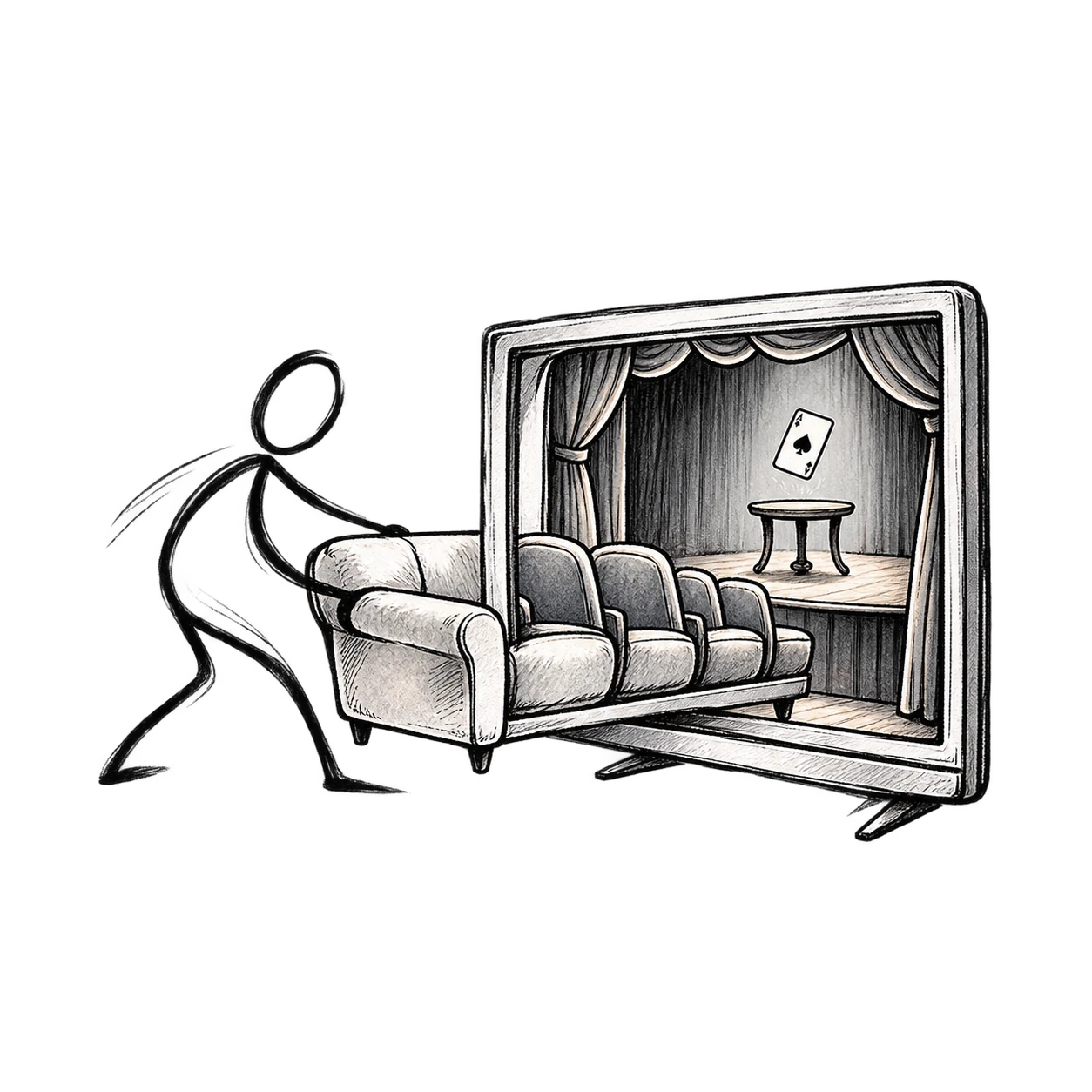
There is a larger bet underneath. At a moment when any video can be faked, Justin has doubled down on the thing that cannot: a room full of people watching the same hands at the same time. His special was built to make a couch feel like a seat in the theater, and his touring schedule now runs into 2027. He is treating liveness as the product.
Three rooms that built the act
Trained by the toughest crowds
Before the Netflix audience, Justin Willman learned his trade in three rooms where nobody is polite. Each one left a mark on the show he tours today.
The birthday party
His first paid audiences were children, who announce exactly what they are thinking and are far harder to misdirect than adults assume. Working for them taught him to earn attention rather than expect it, and it is why kids still come on stage in his biggest shows.
The comedy club
Years on the club circuit meant late crowds, heckles and no children in sight. The rooms demanded a joke rate as high as any stand-up's, and the magic had to survive it. That is where the act became comedy first, with astonishment as the punchline.
The college campus
After graduating he toured campuses across all fifty states, and the signature bit was born: an audience member shouts a ZIP code, he names the town. A real feat of memory sits inside the illusions, so the crowd can never be sure which parts are trick and which are skill. It also makes a stranger feel recognized for where they come from.
A trick has to be about something
The traditional magician persona is a powerful, unknowable figure who never fails. Justin plays a dad from the suburbs who happens to be able to do this, and the choice shapes everything he makes. Episodes of his show were anchored by themes rather than stunts. When his young son asked him to explain inflation, the answer became a routine. Fatherhood went into the act as soon as it arrived in his life.
What this reveals is a writer's discipline inside a magician's craft. A method on its own is a puzzle; audiences solve puzzles and move on. Justin treats the method as a delivery system, and the idea it delivers (a joke, a confession, an argument about money) is what people carry home. It is the same reason his best clips travel so widely: a trick that is about something can be retold, and the one where he convinced a man he was invisible was retold in living rooms all over the world.
The host underneath
Justin studied broadcast journalism at Emerson College in Boston, and the degree matters more than it might appear. A journalism degree is training in walking up to strangers, asking them questions, and keeping them comfortable while a camera watches. That is precisely the skill Magic for Humans runs on, since every participant is an unpaid passerby on a Los Angeles street.
It is also the skill that made him a television host for years, steering Cupcake Wars on Food Network and later Baking Impossible on Netflix. Those jobs and the magic are usually described as separate careers. They look to us like one talent pointed in two directions: reading a person in real time and knowing what will put them at ease. The audiences who found him through baking competitions and the audiences who found him through magic now sit in the same theaters, which may be the most satisfying merger of his career.
- For his own handsSt. LouisTwo broken arms, six months in casts, and a doctor's prescription of card tricks to bring the dexterity back. The first audience was his parents and a six-year-old sister recruited as assistant.[3] [5]

- For strangers on the streetMagic for Humans, NetflixUnpaid passersby on Los Angeles streets, no camera tricks, and a magician who lets his own struggles into the act instead of playing the infallible wizard.[4]

- For the whole family in one rowMagic Lover and the One For The Ages tourA stage show built so that a child, a couple and their grandparents share the same astonishment, and so that someone watching on a couch feels seated in the theater.[1] [2]

The cards came back around
The origin story is well known: two broken arms at 12, and a doctor who prescribed card tricks to rebuild the dexterity in his hands. What is less known is that Justin now serves as magic director of MagicAid, a nonprofit that teaches medical students to perform magic at the bedsides of hospitalized children. During the pandemic he hosted a virtual show for the organization that reached thousands of young patients across dozens of hospitals.
We will not pretend one caused the other. But there is a pleasing symmetry in a man whose first deck was a medical device spending part of his adulthood making sure other kids in casts get a deck too. It also tells you how he understands his craft: as something that does people good, measured in the faces of the audience rather than the cleverness of the method.
One for the ages
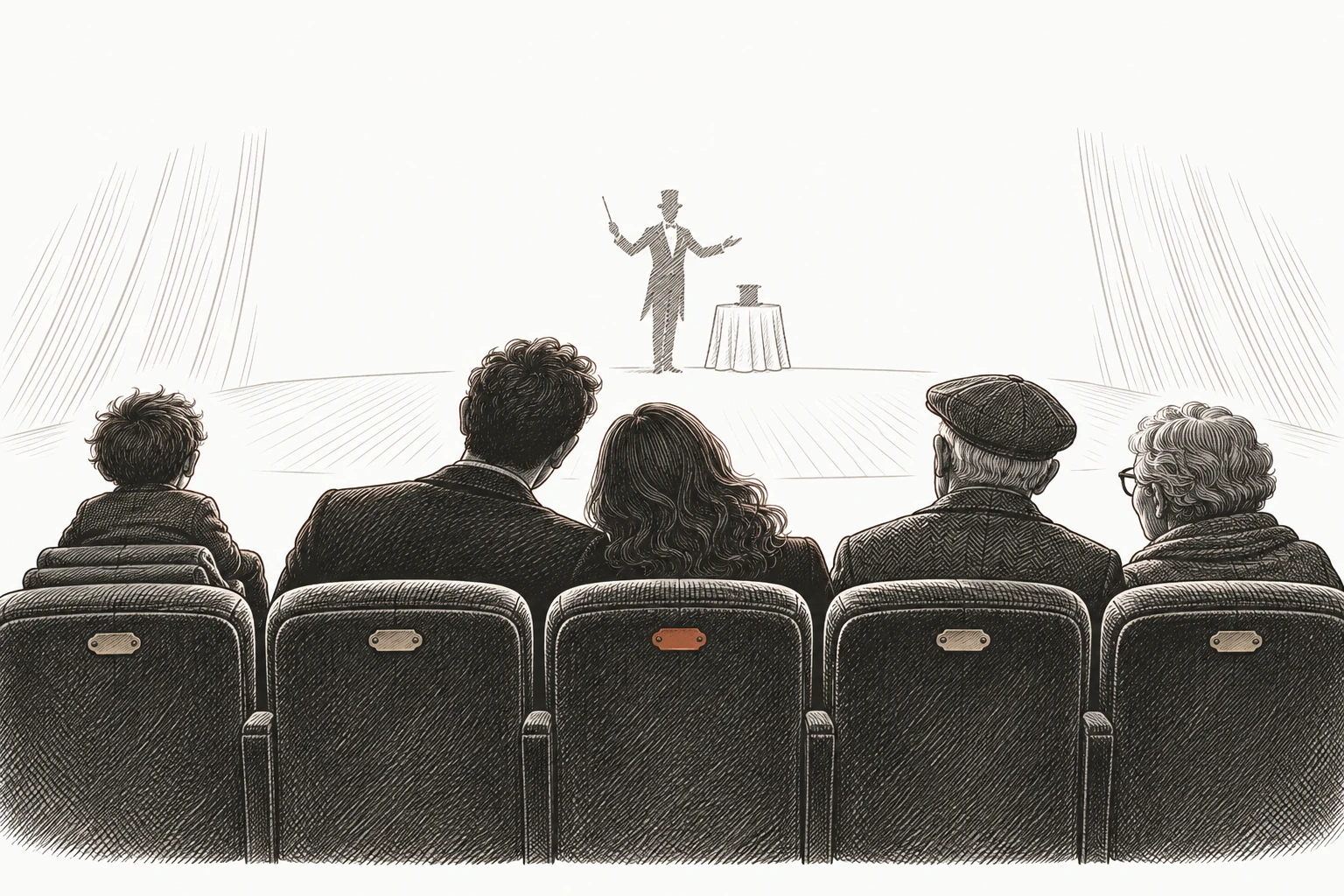
His current tour is called One For The Ages, and the pun is the business plan. The show is rated for ages eight and up, with a warning about occasional grown-up humor and a few spooky moments, which means the same ninety minutes has to land for a second-grader, a couple on a date and the grandparents who drove everyone there. That is a hard room to write for. Justin's show holds it because he spent his formative years in three of the least forgiving rooms a performer can face: children's birthday parties, comedy clubs and college campuses.
The reward has come from both directions at once. In 2024 the Magic Castle, the Hollywood club that functions as the guild of working magicians, named him its Stage Magician of the Year, and the following summer Netflix put his stage act in front of its worldwide audience. Being prized by the insiders and the public simultaneously is unusual in any art form. There is also a time-travel routine on the horizon, an idea he has carried around for years while waiting for the right way to stage it. Given how long his best material simmers before it is ready, that one should be worth the wait.