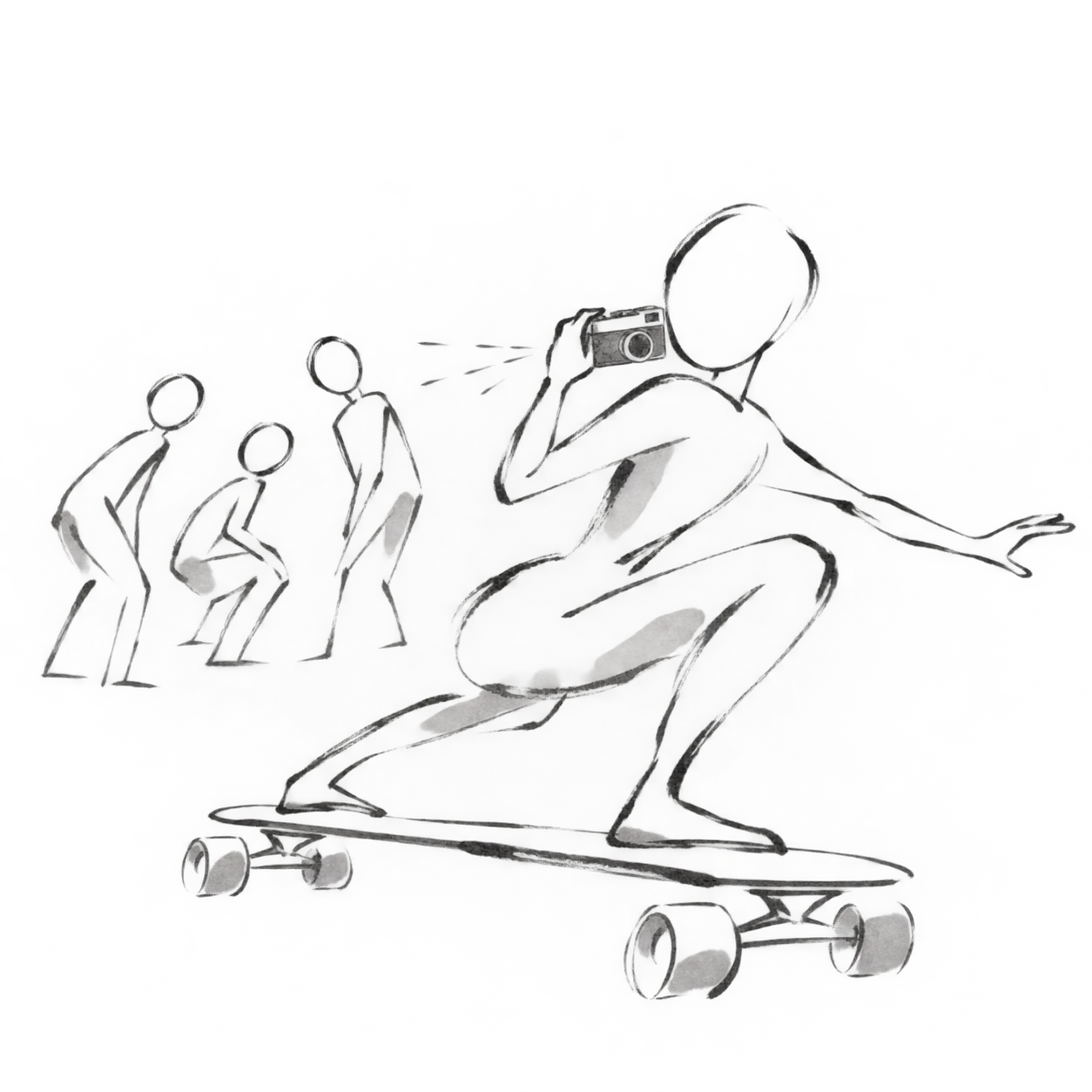
Kevin Michael Connolly is a writer, photographer and graphic designer in Helena, Montana, who was born without legs and spent his twenties winning an X Games medal, publishing a memoir with HarperCollins and hosting a Travel Channel series. What caught our attention is the idea underneath all of it: he took the thing people did to him every day, the stare, and turned it into an instrument for studying them. Then, with the same hands that built his own ski, he started building things for other people.
The guess says more about the guesser
The famous project is easy to describe. Between 2005 and 2011, Kevin rode a longboard through 31 countries and photographed, from hip height, the faces of people looking at him: more than 35,000 frames, later shown at the Smithsonian and the Kennedy Center. Described that way it sounds like a project about him. It is really a project about everyone else.
Here is the part we find most interesting. The looking was the same everywhere. What changed was the story each place reached for to explain him. In New Zealand, surf country, a child wondered about a shark. In a Helena bar, a man assumed Iraq. In Sarajevo, where landmines had taken limbs within living memory, strangers apologised to him and pressed food into his hands. Kevin was the constant; the explanation was the variable. Read the archive that way and it stops being a collection of awkward moments and becomes a map of what each culture fears, remembers and reads in the news. He had built, almost by accident, a portable survey of the human imagination, and he was the control sample.
It takes a particular temperament to run that experiment for six years without turning bitter or preachy, and the photographs do neither. They are curious about curiosity.
What a stare contains
The camera pointed the other way
Kevin Connolly was born without legs and gets around on a skateboard. For six years he photographed the faces of people looking at him. Here is how the project changed shape as it travelled.
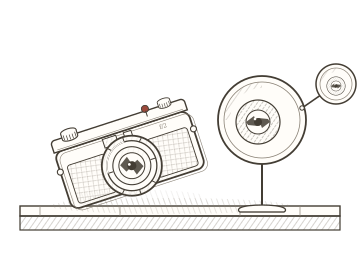
Vienna, 2006: the first frame
A group of teenagers took a phone picture of him in an alley. He lifted his own camera and took one back. The exchange was even now, and he realised he could keep it that way.
The guess changes with the postcode
In New Zealand a child asked about a shark. In a Helena pub a man asked about Iraq. In Kiev a woman pressed money into his bag. Same look everywhere; a different story attached to it in each place.
Sarajevo: the mirror
In a city where mines had taken limbs, strangers apologised to him. Then he noticed himself studying a man missing an arm and a leg, wondering what had happened. The project stopped being about them and became about all of us.
Why the book is called Double Take
The first look is reflex; nobody can skip it. The second look is where the story gets invented. His work lives in the gap between the two, and asks what you put there.
Build the tool, then ride it
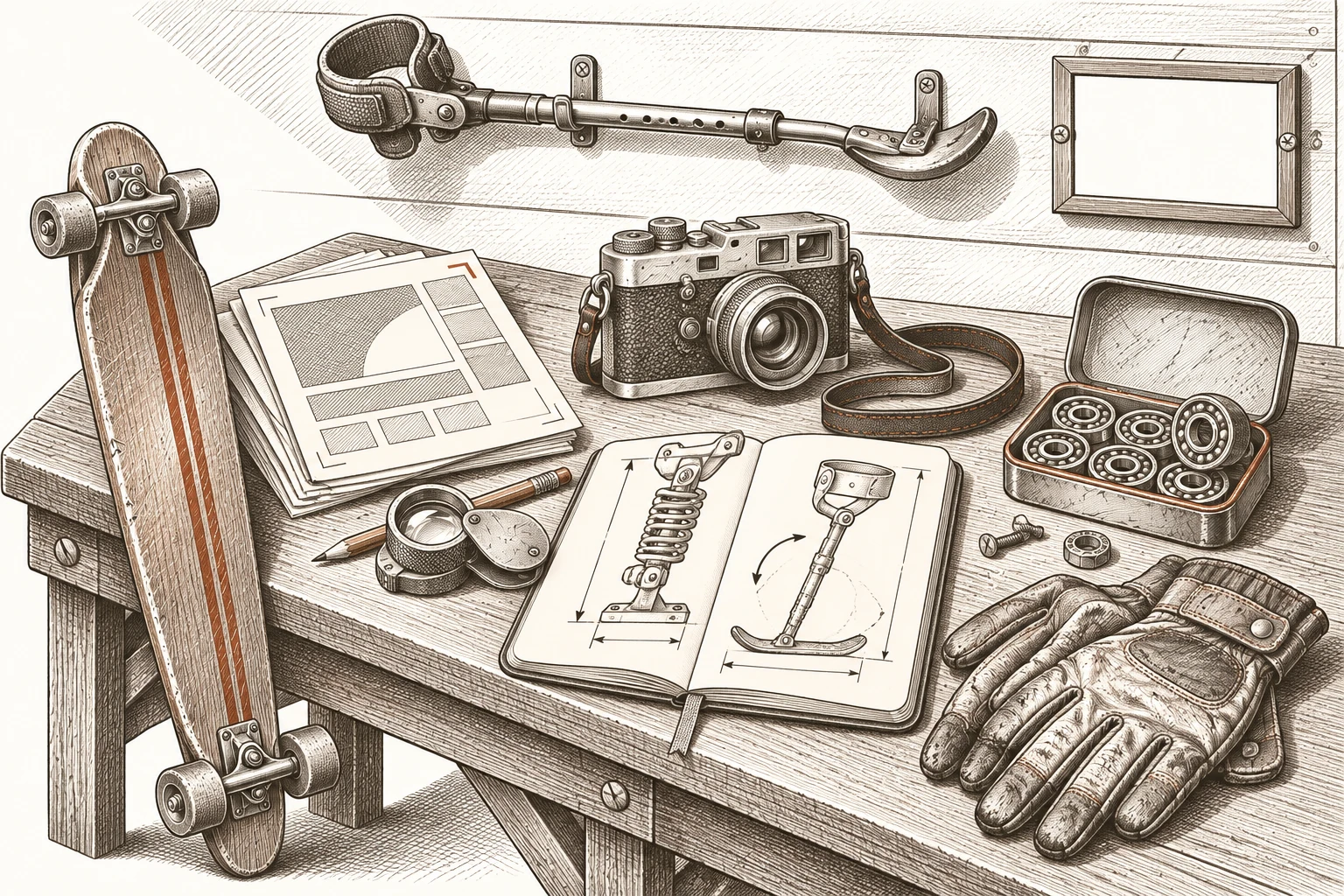
A detail that tends to get lost in the headline version: Kevin designs his own equipment. He uses a skateboard rather than a wheelchair because it is faster, packs into a carry-on and has parts you can buy at any skate shop. The mono-ski he raced at the X Games (silver in 2007, bronze in 2010) was a carbon-and-titanium rig he developed with a Bozeman binding company, with a snowmobile piston for suspension. He has worked with a product-design firm on spring-loaded crutches and strapped a camera to his ski tip to see what the run looked like from the snow. He grew up in a household where his father built solutions out of leather, plastic and whatever was lying around, and the habit of looking at a problem and reaching for a tool clearly stuck.
That is the thread we would follow into his current work, because it explains a career move that looks like a swerve and isn't. His design portfolio reads the way an engineer's would: perfect bind, satin finish, foil-embossed cover, saddle stitch, prepress handled personally. Reconstructing three years of a Montessori teachers' academic journal from old Word files and scanned pages is not glamorous, but it is exactly the sort of job that rewards someone who enjoys making a thing work in the physical world. A brochure is a mechanism too. The man who tuned a bucket seat for a race course now tunes gutters and bleed margins, and we suspect he gets a similar satisfaction from both.
- The skateboard decisionHelena, MontanaFaster than a wheelchair, lighter than prosthetics, and every part replaceable at a skate shop. A mobility choice made on performance, and the platform for a six-year photo project.[5] [8]
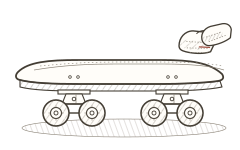
- A ski of his own designBozeman, MontanaA carbon-and-titanium mono-ski with a snowmobile piston for suspension, developed with a local binding company and raced at the X Games.[8]
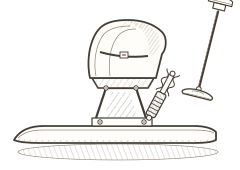
- Prepress as engineeringHelena, MontanaStatewide brochures with foil-embossed covers and saddle stitching, academic journals rebuilt from scans: the same attention to how a thing is made, applied to paper.[4]
The shows he didn't make
By 2010 Kevin had fielded calls from Oprah, Ellen and Dr. Phil and had been offered several cable series. He declined them. The programmes on offer wanted a familiar shape, the disabled saint, and he had no interest in playing it. When he finally did make television, the 2013 Travel Channel series Armed & Ready, it was a show about doing things: cliff diving in Hawaii, lumberjack sports in Tennessee, army training, rolling down a hill inside a giant inflatable ball. The premise was activity, and the disability was simply the body doing it.
The same instinct shows up earlier. People who watched him ski as a teenager thought he could have gone all in and medalled at the Paralympics; he kept skiing as the thing he loved rather than the thing he was for, and when competition started costing him, he traded big jumps for a thousand ordinary days at Big Sky. There is a consistent preference here for the version of a thing he can actually live inside over the version that scales. It is a kind of editing, applied to a life, and it is a skill worth studying for anyone who has ever been offered a bigger stage on terms they didn't like.
Helena, on purpose
Kevin now lives and works in the town where he was born. He writes and designs for Montana clients, from a statewide real estate brokerage to that Montessori association, and he produced the full marketing suite for Lame History, a podcast in which three disabled hosts tell the stories of disabled figures from ancient Egypt to the twentieth century. The title alone tells you his sense of humour has not softened: take the word people use against you and put it on the poster. In 2022 he wrote and designed a television pitch deck on spec, so the appetite for a big idea hasn't gone anywhere either; it just shares a desk with client work.
In 2023 he gave the commencement address at Helena High, twenty years after graduating from it. We like that fact for what it says about proportion. He has spoken at the Smithsonian and the National Press Club, and the room he chose to mark two decades was a gym full of eighteen-year-olds from his own town.
It would be easy to end on the word inspiring, and it would miss the point. What we admire is more specific: a mind that treats every awkward constraint as a design brief, that turned a lifetime of being looked at into a study of the lookers, and that kept saying no to the easy story until it could tell a better one. Those are habits anyone can borrow, and they are why a designer working out of Helena remains one of the more interesting people to have come out of Montana.