
Mohnish Pabrai runs investment funds from Austin, Texas, and an education foundation that has placed thousands of rural Indian students into the country's most competitive engineering and medical colleges. What caught our attention is how little he minds whose idea something was. He has built a career, a book, a fund structure and a charity out of finding what already works and reproducing it with unusual care, and that turns out to be a far more demanding talent than it sounds.
The craft of copying well
Value investing, the school Mohnish belongs to, is the plain-spoken end of finance: buy a business for less than it is worth, then wait. Warren Buffett is its patron saint. Plenty of managers claim to follow him. Mohnish went further and copied the paperwork. When he started Pabrai Investment Funds in 1999, he lifted the terms of Buffett's original 1950s partnerships: no fee for simply managing the money, and a share of profits only after investors had cleared a hurdle themselves. In an industry that had long since standardised on charging both ways, this was an old contract brought back into use, and it tells clients exactly where he thinks the risk should sit.
He came to all this sideways. A computer engineering degree from Clemson led to a research job at Tellabs in the late 1980s, then a move into the company's international sales and joint ventures, which is an early sign of someone more curious about how businesses make money than about the circuitry alone. In 1990 he started an IT consulting firm from his home in Illinois, funded with his retirement savings and a stack of credit cards, grew it to over 160 people and an Inc. 500 listing, and sold it in 2000. The fund had begun as a side project the year before. Only after the sale did it become the job.
How Mohnish keeps score
Same cards, different hands
Three places where Mohnish has chosen a scoring system that strips out luck and measures only the decision. It starts at the bridge table.
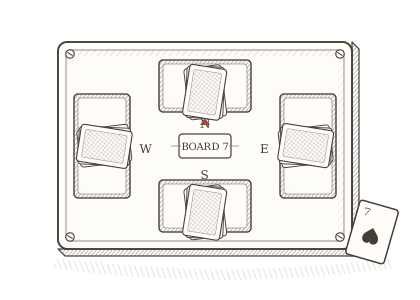
The bridge table
His game is duplicate bridge, where every table plays the identical deal. You cannot win by being dealt good cards; you win only by playing the same cards better than the next table did. It is hard to think of a cleaner training ground for someone whose job is judgment under uncertainty.
The 1950s contract
His private funds revive the terms Buffett used in his original partnerships: nothing for managing the money, a share only once investors have cleared a hurdle. The manager is scored on what he adds, never on the size of the pile.
The foundation's ledger
Dakshana is run with a cost per scholar, a placement rate and an estimate of the lifetime income each seat unlocks. A charity measured like a business sounds cold until you see the numbers: more than half of its scholars have gone on to the IITs.
The thing to notice about his copying is the ego required for it. Reproducing someone else's model at scale takes real nerve; doing it without needing the credit takes a particular kind of self-possession. Most of us can manage one or the other.
Dhandho, dakshana, chai
Listen to the names Mohnish gives things and a worldview comes through. His 2007 book is The Dhandho Investor: dhandho is a Gujarati word for business as an endeavour, and the book draws its central lesson from Gujarati immigrants who bought up American motels with small down payments and almost no way to lose much. His holding company is Dhandho Holdings. His blog and YouTube channel are called Chai with Pabrai. And his foundation is Dakshana, from the Sanskrit for the offering a student gives a teacher at the end of their instruction.
That last name is the revealing one. Mohnish has spent decades positioning himself as a student: the annual trip to Omaha for Berkshire Hathaway's meeting, the lunch with Buffett in 2007 that he and a friend won at charity auction for $650,100, the nine years of showing up to a Harvard Business School seminar for company presidents until the school made him an alumnus. Naming his life's philanthropic work after the fee paid to a guru suggests he sees the whole enterprise as settling a debt to his teachers. It is an Indian framework for a career spent in American capital markets, and he has never seemed to feel any need to translate it away.

The cheapest link in an expensive chain
Dakshana is where the investor's eye shows most clearly. India's government runs a network of free residential schools for gifted rural children, and it heavily subsidises the Indian Institutes of Technology, whose entrance exam is among the hardest in the world and whose degree can move a family's economics permanently. The state, in other words, was already paying for the talent at the start and the education at the end. What was missing was the year or two of intensive exam coaching in between, which poor families could not buy. Mohnish funded only that missing piece. A few thousand dollars per student, placed at the one point in the chain where the leverage was enormous.
The model itself was borrowed, from a Bihar maths teacher who coached thirty poor students a year into the IITs and declined to take outside money. Mohnish asked if he could replicate it instead, and built the organisation from California, expecting a long run of failure before anything worked. It worked within months. By 2025 Dakshana had inducted more than 9,000 scholars, placed two-thirds of that year's engineering cohort into the IITs, and opened a 109-acre residential campus. In fifteen years it gave to no other cause, with a single exception for earthquake relief in Turkey in 2023. The same concentration he applies to a portfolio of roughly twenty stocks runs the foundation.
- A company from the spare roomTransTech, IllinoisFunded with retirement savings and credit cards, so the worst case was survivable and the upside was open. It grew to 160 people and was sold a decade later.[3]

- A fund run as a hobbyPabrai Investment FundsStarted on the side while still running the consultancy, on borrowed 1950s partnership terms. It became the full-time job only after the company sale in 2000.[3]

- A charity built to fail slowlyDakshana FoundationLaunched in India from California with a ten-year allowance for things to go wrong. It found traction within weeks and now runs its own campus.[7] [4]

- A retail fund, then an ETFPabrai WagonsA mutual fund for ordinary investors was tried first, then converted into an exchange-traded fund in 2026 with a single lower fee, once the format had proved itself.[1]

An investor with nothing to hide
Fund managers tend to guard their thinking. Mohnish publishes his. There are lectures at Peking University and the University of Puerto Rico, dozens of interviews a year, and transcripts posted on his own site for anyone who prefers reading. We suspect there is cold logic underneath the generosity: if your edge is patience and temperament, as his is, explaining it costs you nothing, because so few people will sit still long enough to use it.
The latest chapter follows the same logic. After two decades of private funds open only to the wealthy, he launched a retail mutual fund in 2023 and converted it into an exchange-traded fund in early 2026, with a single lower fee and no minimum beyond the price of one share. Anyone with a brokerage account can now ride along. For someone in his early sixties with a campus still filling out near Pune and a strategy he has never kept secret, it reads as an act of distribution: the student making sure the lesson travels further than he will.