
Stefan Sagmeister is an Austrian designer who has run a small studio in New York since 1993, won two Grammys for album packaging, and then spent the second half of his career asking what design can say when nobody has hired it to sell anything. The answers have filled museums on three continents: a show about happiness, a show about beauty, and now a growing body of work arguing, with two centuries of data, that the world is doing better than the news suggests. We looked closer because very few people in his field have changed what their field is for, and he has done it while staying recognisably the same person.
The first poster
He grew up in Bregenz, in Vorarlberg, the narrow western tip of Austria that touches Lake Constance and leans toward Switzerland as much as toward Vienna. It is a region of makers and family firms, and the Sagmeisters were one of them: a clothing store carried through several generations, with a grandfather who had trained as a sign painter before the shop claimed him. There is something fitting in the fact that the youngest child of that house became a designer whose work hangs on walls, since the one piece of the grandfather's craft that survives hangs in Stefan's apartment on 14th Street.
His own start was a teenage one, laying out a small youth magazine and wheat-pasting its concert posters around town. What strikes us about that story is less the precocity than the feedback loop. A poster went up, and a few hundred people appeared at a concert who would otherwise not have known it existed. Design, at fifteen, was already something whose results could be counted. That habit of checking whether a piece of work actually did anything in the world never left him, and it explains a great deal about the choices that came later.
Learning the language before changing it
After Vienna's University of Applied Arts, a stint in Hong Kong and a formative period at Tibor Kalman's M&Co in New York, Stefan opened his own studio in 1993 and became, within a few years, the person musicians called when they wanted a record sleeve that people would actually look at. Lou Reed, the Rolling Stones, David Byrne, Talking Heads: the covers from this period are still taught, and two of them won Grammys.
The pivot we find most interesting came from an unusual decision he took around 2000: to close the studio to clients for a full year, and to do that again every seven years. The first sabbatical is usually told as a story about rest. It reads to us as a story about ambition. He came out of it having realised that design could carry an idea of its own, with no product behind it, and he tested that by taking sentences from his private diary and setting them into billboards, magazine spreads and public installations. The work became the long project Things I Have Learned in My Life So Far, and it widened what a graphic designer was allowed to be: a person with something of their own to say, using the tools of a trade built for saying things on behalf of others.
Designing for everyone else
Designing for everyone else
A designer admired by his peers who decided, early and firmly, that his peers were not the audience. Four observations on who his work is for and how he knows it is working.
The public, not the profession
His exhibitions on happiness and beauty drew hundreds of thousands of visitors, most with no design background. Some avant-garde colleagues found them too accessible. He treated that as confirmation: a show about wellbeing that only designers could read would have failed at its own brief.
Success has to be checkable
He calls everything he makes design, even the gallery paintings, because each piece has a job. The current works exist to hang in a home and counter the week's headlines. When the first set sold out, that counted as evidence the design worked; had it not, the design would have changed.
The seven-year clock
Every seventh year the studio closes to clients. The breaks are expensive and frightening to schedule, and each one has handed the studio its next subject. It is a renewal mechanism built into the calendar rather than left to chance.
Back in the same building
In 2013 the Gaîté Lyrique in Paris hosted The Happy Show. In October 2026 it reopened its large exhibitions with his new work on long-term progress. Same rooms, a different question, and the same general public filling them.
A studio that runs in chapters
Most creative businesses are shaped by whatever clients happen to arrive. Stefan's has been shaped by the calendar. Every seven years the client work stops, a year of experiments follows, and the studio comes back with a new subject it will stay on for most of a decade. Happiness filled the years after the second break, producing a touring exhibition and a feature-length film in which he was his own test subject. Beauty followed, with a show that opened in Vienna in 2018 and is still travelling. The current chapter is about time itself.
What we admire here is that the sabbatical is a structural device, not a holiday. It makes the studio behave more like a research lab than a service business: a small team (he has long preferred a handful of people over growth) that is allowed to get better at one question for years. In an industry where novelty is the currency, choosing depth over breadth every seven years is an unusually patient operating model, and it has turned out to be a commercially sound one too.
- Record sleevesLou Reed, Rolling Stones, Talking Heads, David ByrneWork made to be held for the life of an album. Two Grammys came from this period, and the habit of designing for an audience that would look closely.[9] [10]
- Rooms people walk throughThe Happy Show, BeautyMuseum exhibitions on happiness and beauty that toured for years and reached visitors who had never thought about design. The medium now lasts a decade and travels.[3] [10]

- Objects meant to reach 2200Now Is Better, Bentonville, Toronto, RessenceLong-term data placed in two-century-old paintings, stone mosaic, hospital tunnels and a mechanical watch. The subject is time, so the carrier is chosen for how long it will survive.[4] [7] [2]
Optimism with receipts
The present project began with a dinner-table remark in Rome about the death of democracy, and with Stefan doing what he tends to do: looking it up. The numbers said the opposite of the remark. Two hundred years ago there was one democracy; now more than half of humanity lives in one. Child survival, literacy, calories, the share of people in extreme poverty: on almost every long series, the line goes the right way, with setbacks along the route.
There is a lovely irony in who is making this argument. Stefan was formed in Vienna, the city of Freud and of a certain elegant pessimism, where cheerfulness can be treated as a lapse in intelligence. His optimism comes from method rather than mood. He is as drawn to bad news as anyone (he is candid about that), which is exactly why the work is built on measured series from the UN and the World Bank rather than on mood. The lesson for the rest of us is portable: hold two lenses, the daily one and the two-hundred-year one, and notice which one you have been using.
Choosing a medium by its lifespan
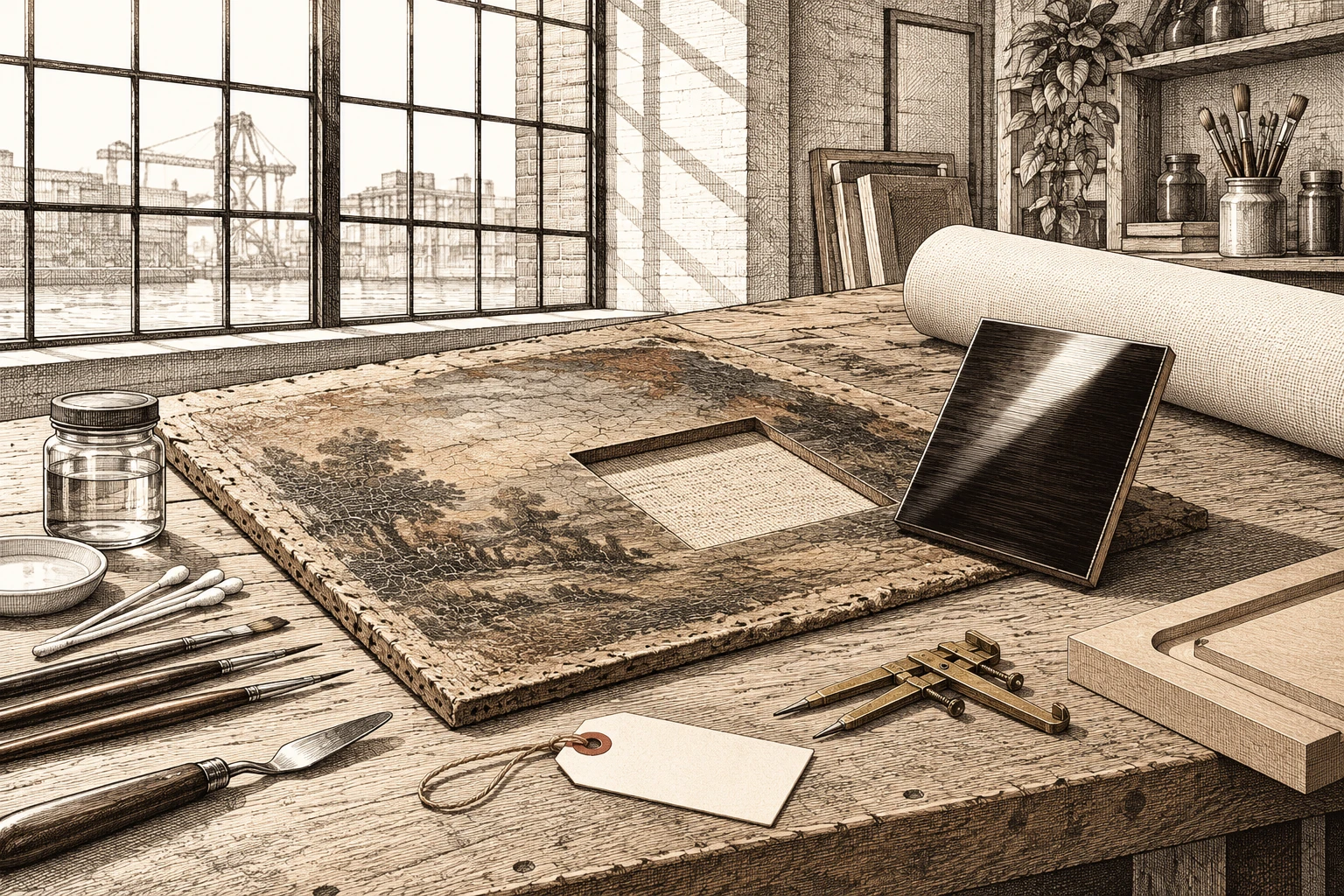
The decision we would single out as the most original of his later career concerns materials. Having settled on long-term data as the subject, he rejected every digital format, partly because he could not open his own files from fifteen years earlier. Instead the visualisations are set into 18th- and 19th-century paintings bought at small Central European auction houses, cut open and fitted with polished inserts, then restored by a full-time conservator on his team at the Brooklyn Navy Yard. Other pieces are stone mosaic set into a bike path in Arkansas, tiled hospital tunnels in Toronto, a mechanical watch too expensive not to be cared for. The carrier is chosen to outlast the argument.
Look back across the career and the lifespan of his media keeps lengthening: a record sleeve, a billboard, an exhibition, now objects designed to be around in 2200. He still calls all of it design, and insists he is not an artist. We think he is right, and the reason is that counting habit from Bregenz. The paintings have a job: to hang in someone's home as a reminder that the week's headlines are not the whole story. When the first set sold out, that was treated as evidence the design worked. Had they not, he would have changed the design.
Now
The fourth sabbatical, spread across Madrid, Guadalajara and Buenos Aires, ended last year. Its first visible result opened in October 2026 at the Gaîté Lyrique in Paris, the same building that hosted The Happy Show thirteen years earlier, under a title that arrived in Spanish before English: Finally, Something Good. Mumbai, Vienna and Frankfurt follow through 2027.
Stefan is in his sixties and teaching at the School of Visual Arts, and he is doing the thing he has recommended to younger designers for decades: looking for the nervous feeling that means the work is new. Whether or not one shares his reading of the data, the shape of the career is worth studying. He kept the craft, changed its purpose, built a calendar that forces renewal, and matched every message to a material that could carry it for as long as the message needed. That is a designer's answer to the question of how to stay useful for forty years, and it is a good one.