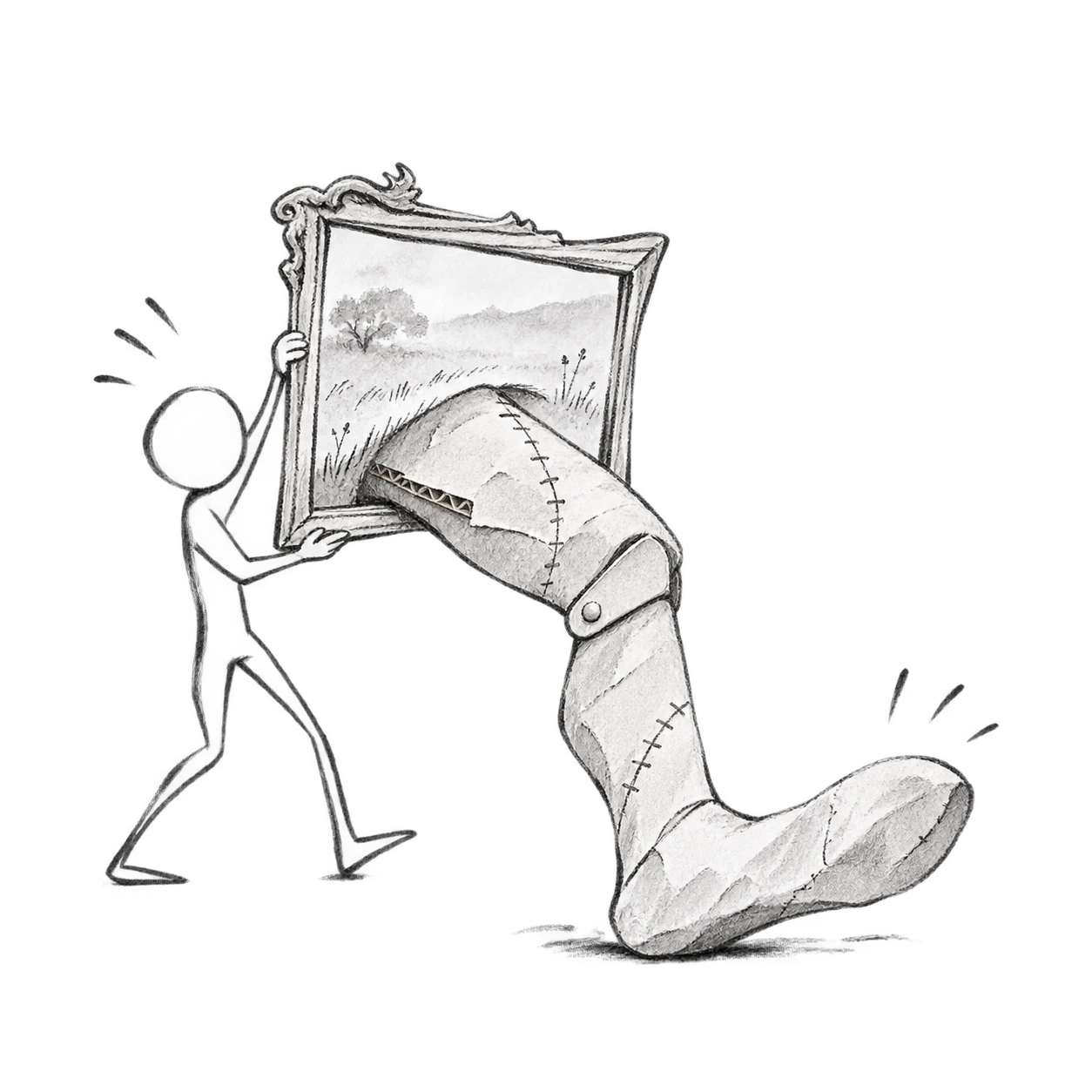
Wayne White makes paintings you can read from across a room, puppets big enough to walk between the legs of, and television sets (the built kind, made of plywood and paint) that a generation of children grew up inside. He helped create the look of Pee-wee's Playhouse, the wildly inventive Saturday-morning children's show of the 1980s. He art-directed some of the era's most-watched music videos. Then he became one of America's best-known word painters, artists whose paintings are built around text. What caught our attention is that a single way of seeing runs through all of it: a draftsman's eye that keeps finding possibility in things everyone else has stopped looking at.
The co-signed painting
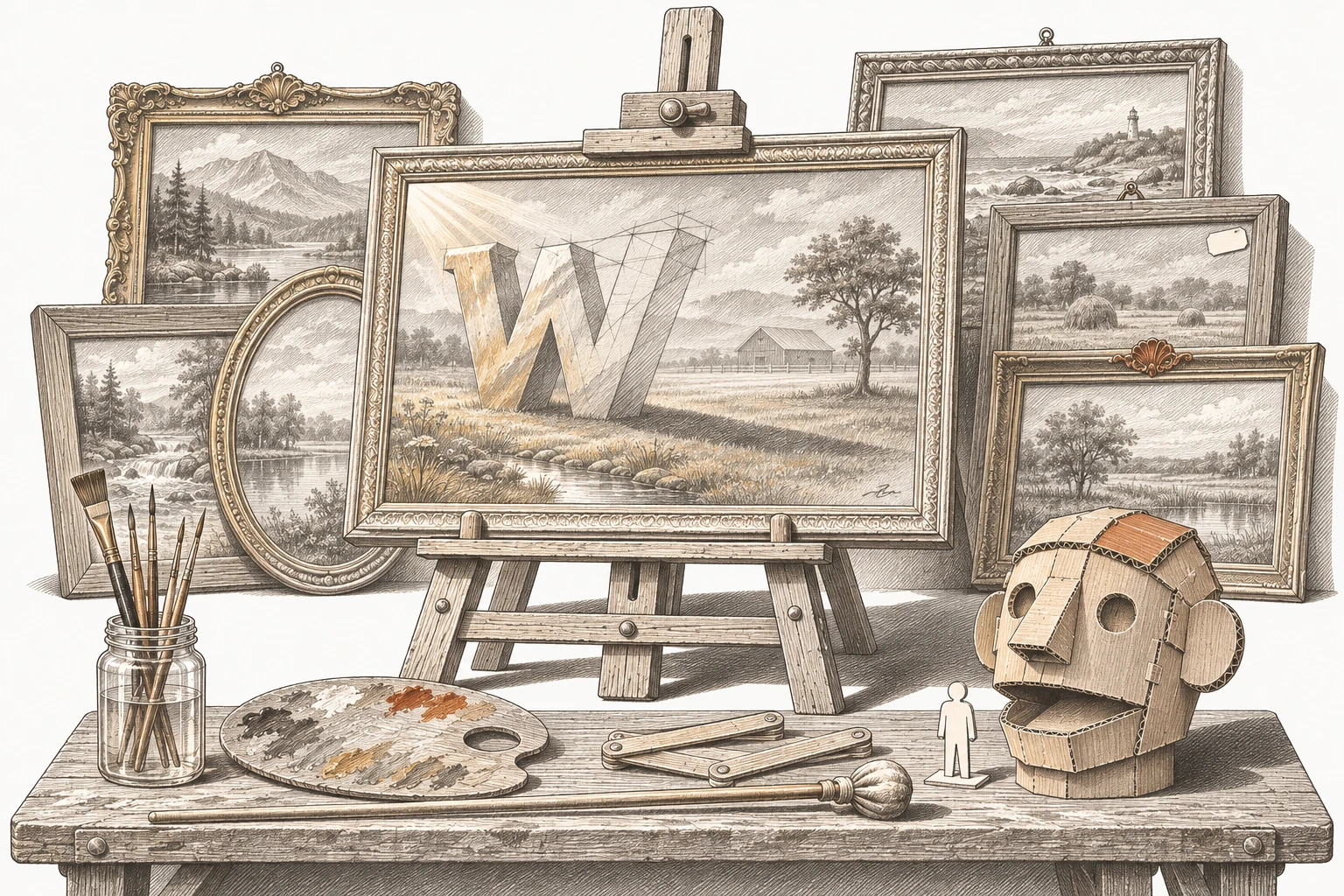
Some context for anyone who missed the 1960s and 70s: American department stores once sold landscape paintings along with the sofa they were meant to hang above. Misty barns, autumn creeks, a lone cabin by a lake. Millions of these mass-produced reproductions went into living rooms, and decades later they went to the thrift store. That is where Wayne finds his canvases. Across them he paints enormous words that look three-dimensional, like giant block letters standing in the landscape. He draws them in proper perspective and lights them with the same weak sun the original painter put in the sky.
Two choices tell you most of what you need to know about him. He works only on the reproductions, never on an original, and he leaves the first painter's signature exactly where it was. So the joke, when there is one, is never on the painter. And making giant letters sit convincingly in a stranger's meadow takes real skill. He has to study that stranger's light, colour and atmosphere so closely that his additions feel as if they were always there. That is a painter's discipline wearing a comedian's hat. It also says something about his values: he would rather give a used-up object a second audience than wreck something a person once loved. There is a lesson in it for anyone stuck in a crowded field. The medium nobody respects is the one where nobody is watching, and that is where you get to play.
Comic timing in a still medium
We usually take in a painting all at once. Wayne's paintings have to be read, and reading takes time. You see the scene first, then the shapes resolve into letters, then the sentence lands, a beat late, the way a punchline does. Timing is a performer's tool, and he has smuggled it into a medium that normally has none. Over the years his lettering has grown twistier and more sculptural, which slows the reader down further and stretches out the setup. The title of his 2023 show at the Country Music Hall of Fame, Language is a Trick, reads to us as a magician being honest about where the trick is.
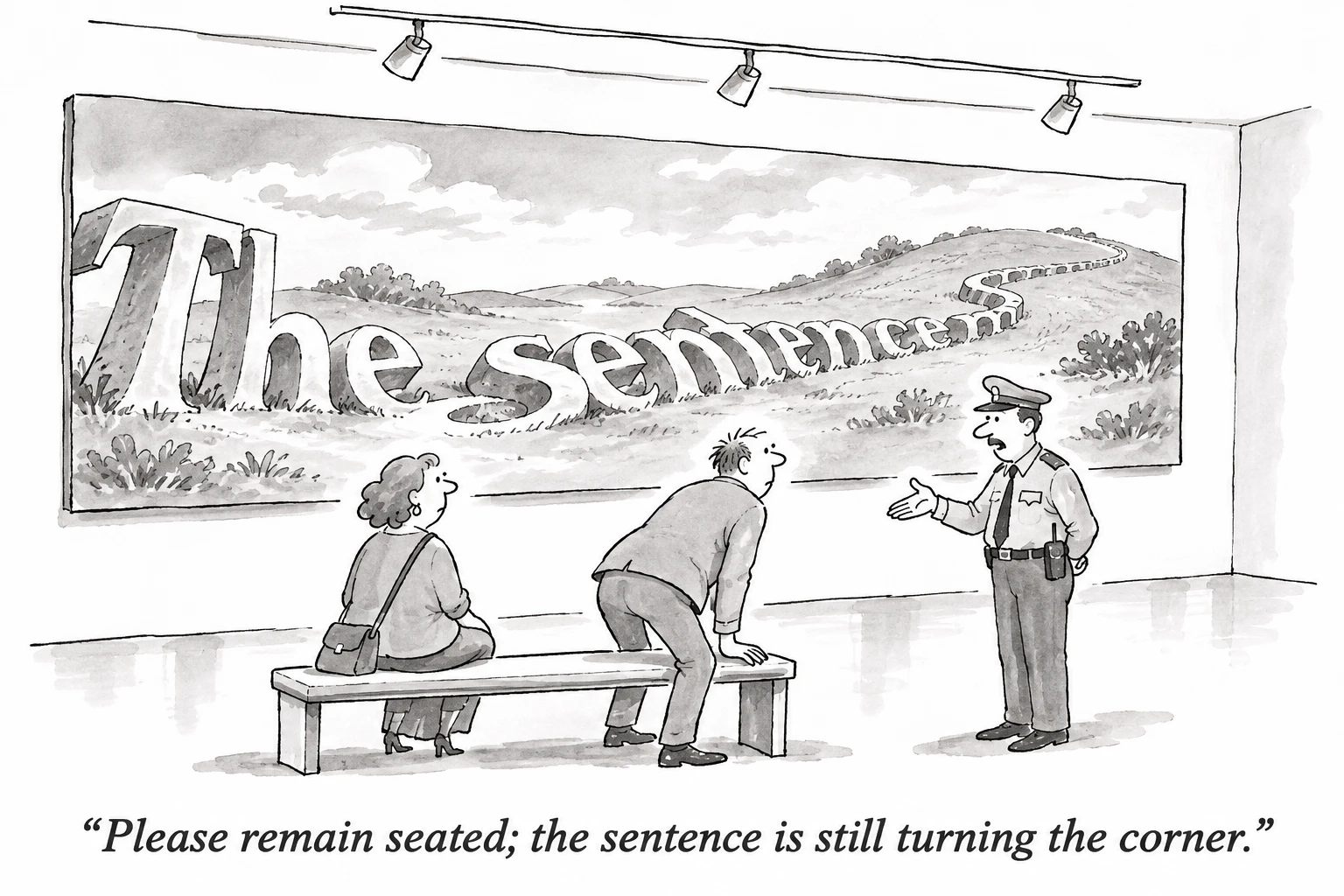
Underneath all this is a cartoonist's hand. He grew up on Mad magazine and the newspaper comics page, and it shows in how his letters behave: they lean, cast shadows, bulge and strut like bodies. A figure painter, someone who paints the human form, would recognise what is going on. Wayne just found his figures in the alphabet.
How to take over a room
How to take over a room
Since 2009 museums have handed Wayne their biggest spaces and he has filled them with puppets the size of buildings. The method behind the spectacle comes from a sound stage, not a studio. Swipe for the four moves.
Win the first second
He designs for the moment a visitor steps through the door, the way a ballpark hits you when you first see the field. The scale lands before any detail does. Then the eye starts finding the smaller things.
Do the homework
Every installation is about the town that hosts it. Houston got George Jones, who started there. Roanoke got its railroad boomtown past. Oklahoma City got a cubist rodeo. York, Pennsylvania got the Confederate soldiers who once marched in and raided its shops. He reads the local history before he draws a line.
Build with what the town makes
In York the figures were corrugated cardboard, because York makes corrugated boxes. In Oklahoma City the palette was the red-brown of the local dirt. The material carries the place as much as the story does.
Build it a quarter bigger
Rooms swallow objects. His rule from the set-building years is to make everything larger than instinct says, then hire a crew of seven or eight artists he trusts and build it on site, in the room, as if it were a set. A small model and some forced perspective, borrowed from theme-park main streets, do the rest.
The set builder in the gallery
The television years are often told as a prelude, something Wayne did before the art world noticed him. We read them differently. Before Pee-wee's Playhouse hired him, he performed puppet shows at parties in downtown New York. Then came years on sound stages. Together they were an apprenticeship in rooms, in crews, and in that first second after a person walks into a space. When he started building large walk-through installations in museums in 2009, he arrived with skills most painters have to invent on the spot. He knew how to read a space and how to manage a crew of seven or eight artists. He knew how to make a twenty-foot idea clear from the doorway and a three-inch detail worth leaning in for. Working at that scale is a craft, and he had already spent twenty years learning it.
Funny on purpose
The art world has long been nervous around laughter, as if a joke must be the opposite of depth. Wayne's whole body of work is an argument against that nervousness, made without ever arguing it. The puppets are hammy, the phrases he paints are rude, and the stage show he tours comes with a banjo and a harmonica. The effect is the warmth of someone who grew up in the Southern storytelling tradition and never saw a reason to put it away. Few gallery painters go on the road like a musician. He does, and the paintings make more sense once you have seen him perform.
Leaving Tennessee to see it
Wayne was born in Alabama and raised in Chattanooga, Tennessee. He studied at Middle Tennessee State University and left for New York in 1980. He later settled in Los Angeles with his wife, the cartoonist Mimi Pond, and they raised a family there. Distance did what distance does to a sharp observer: it turned the South from a background into a subject. He treats it at two temperatures. The region's old male authority figures get satire, served up in a coin-operated peep show. The region's music, from the country singer George Jones to its murder ballads, gets something closer to devotion. Murder ballads are old folk songs that tell the story of a killing, often of a young woman. Over the last decade Tennessee has kept inviting him back: to Chattanooga, to Nashville, and in 2026 to a survey show of his career at the Knoxville Museum of Art. There he built monumental puppets for the Knoxville Girl, the murdered young woman at the centre of one of the best-known ballads, and gave her a stage to come back and stand on. He takes the stories a place already tells about itself and rewrites the ending.
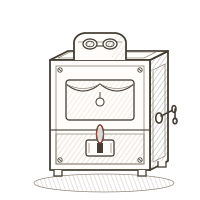
- Satire in a coin slotNew YorkSouthern Daddy Shame Ray, a puppet peep show: drop a quarter and the region's old male authority figures light up. Distance from home gave him a clear enough view of them to make them funny.[3]
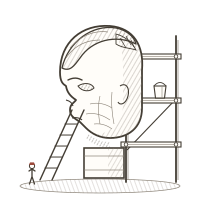
- Devotion at full sizeRice University, HoustonFor a city where George Jones got his start, he built the largest George Jones puppet head anywhere. The same South that gets the satire gets the love, and the love is bigger.[1] [3] [4]
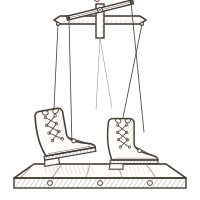
- Rewriting the balladKnoxville Museum of ArtA survey show in his home state, with monumental puppets that give the Knoxville Girl, the murdered woman of an old ballad, a stage to walk back onto. He now takes the South's own stories and changes how they end.[5]
Two artists, one house
Mimi Pond is a cartoonist and graphic novelist, and the couple's two children are artists too. Drawing is the family language. It is easy to underrate how much that matters. A life in the studio is easier to keep going when the people at the dinner table understand a bad day in front of a canvas without needing it explained. The sheer volume of what Wayne has made suggests a household that made room for it.
The next room
Wayne is now in his late sixties. He has a career survey exhibition behind him, a new set of illustrations for a 2024 book about the country duo George Jones and Tammy Wynette, and a run of puppet shows he started posting online during the pandemic. The pattern has held since the Playhouse: each new room he enters, whether a sound stage, a thrift-store landscape or a museum atrium, gets an answer made just for it. We can think of few artists who have made so many different kinds of things with such a recognisable hand, and we will be watching for whatever room he walks into next.